Why Cold Hands Change Your Shot Before the Rest of Your Body Notices
Quick Answer: Shooting touch degrades in cold weather well before your legs or lungs feel any different, because fingertip sensation and fine motor control decline sharply once hand skin temperature drops below roughly 59F (15C) - and hands cool much faster than the rest of the body since blood is being shunted away from the extremities to protect core temperature. Grip strength also declines, tactile feedback from the ball drops, and a colder ball is harder and less grippy. The result is a shot that feels almost right and misses short and flat. Warm hands specifically, not just your body, and expect the first ten minutes to be unrepresentative.
You get to the court on the first properly cold morning, your legs feel fine, your wind is fine, and you cannot make anything.
It is not your form. It is roughly two degrees of skin temperature at your fingertips.
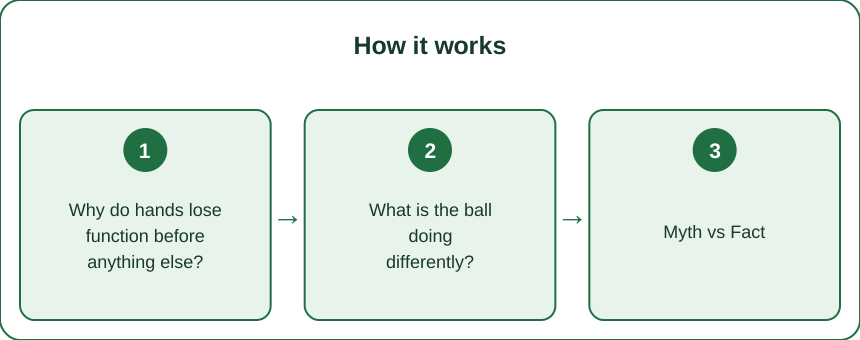
Why do hands lose function before anything else?
Because the body sacrifices them first, deliberately.
When ambient temperature drops, the body prioritizes core temperature. Peripheral vasoconstriction reduces blood flow to the hands and feet dramatically - blood flow to the fingers can fall by a very large margin in cold conditions - which conserves heat centrally at the direct cost of the extremities.
The consequences for a shooter are specific and well documented in the ergonomics literature.
Tactile sensitivity degrades below roughly 8C (46F) skin temperature, and manual dexterity begins declining noticeably below about 15C (59F). Those thresholds are reached at the fingertips far faster than most people expect - a 45F morning with any wind will do it within fifteen minutes of standing around.
Grip strength declines too, by a meaningful percentage in cold hands, and the fine motor timing that governs release is affected more than gross strength.
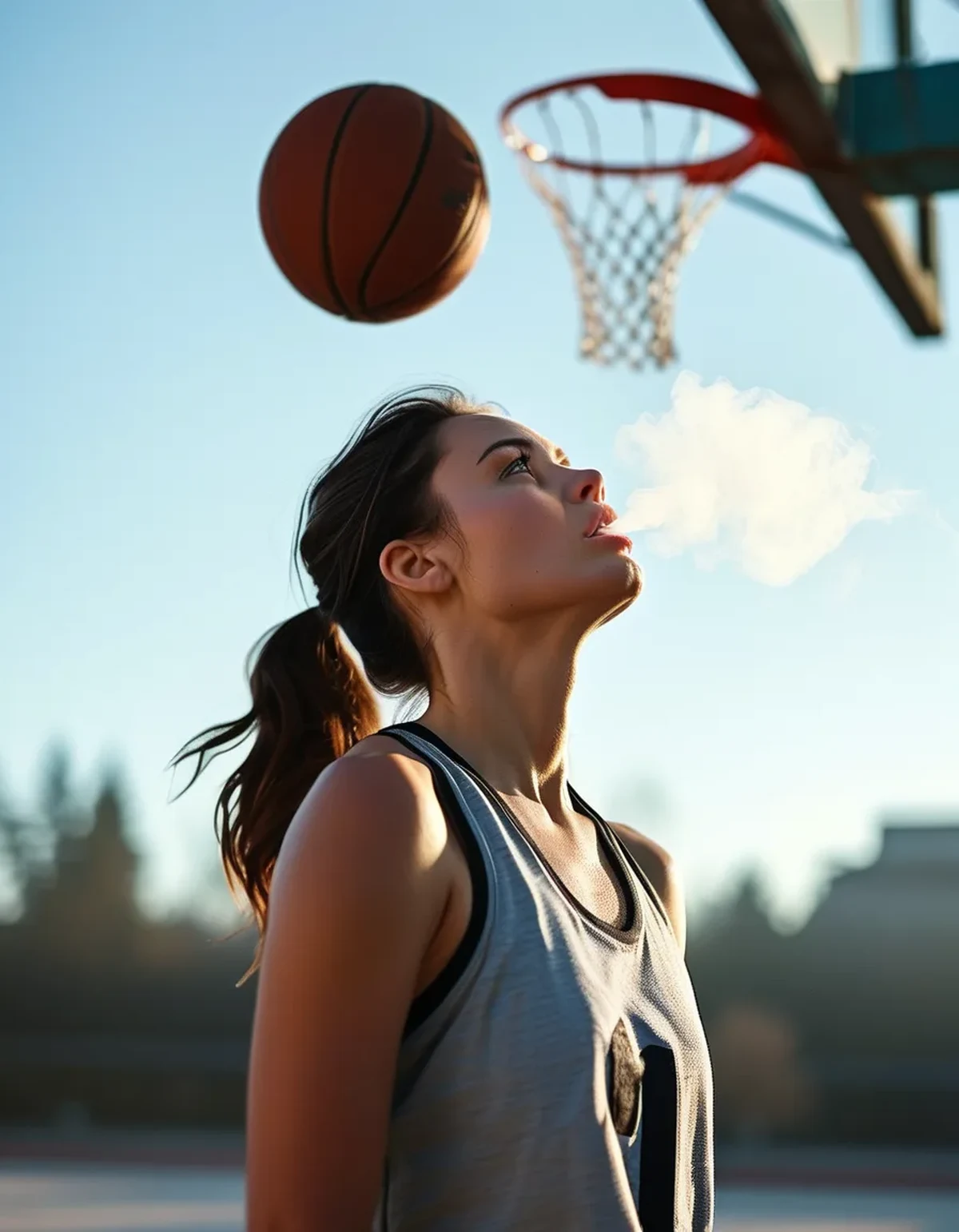
For a jump shot, this matters disproportionately because the last thing that touches the ball is the fingertips, and the final flick determines backspin, direction and arc. You can have perfectly warm legs, a perfect base and a perfect elbow, and lose the shot in the last four inches.
The tell is a shot that misses short and flat with inconsistent rotation. That combination is a fingertip problem, not a mechanics problem.
What is the ball doing differently?
Getting harder, slicker and less predictable off the fingers.
Air pressure inside a basketball drops as temperature drops. The physics is straightforward - roughly a two percent pressure change per 10F - so a ball inflated correctly in a warm house is under-inflated on a cold court, and it will feel dead and bounce lower.
That sounds like it would help touch and it does not. An under-inflated ball deforms more on contact, changes the timing of release, and comes off the fingers differently.
Composite leather stiffens in the cold, reducing the surface compliance that gives you grip. The pebbling that provides friction works less well when the material is hard.
And moisture is the wildcard. A cold outdoor court in autumn frequently has dew or condensation, and a damp ball on cold hands is the worst combination for grip there is. Morning courts are damp long after they look dry.
Practical responses: check ball pressure at the court rather than at home, keep the ball inside a bag rather than on the ground between sessions, and carry a towel. Wiping the ball every few minutes is a genuine performance intervention in autumn, not fussiness.
And if the court surface is damp, adjust expectations for lateral movement too - the shooting problem is the visible one, but a slick surface changes footwork before it changes anything else.
Myth vs Fact: Cold Weather Shooting
Myth: You just need to warm up longer. Fact: Partly true, but general warm-up does not warm hands. Running warms the core, which can actually increase peripheral vasoconstriction initially. Hands need their own specific attention - gloves between reps, hand warmers, or hands in pockets and armpits.
Myth: Shooting more shots will get your touch back. Fact: If your hands are cold, repetition is practising a degraded motor pattern. You are not grooving your shot; you are grooving a compensation. Warm the hands first, then shoot.
Myth: The cold makes you shoot short because your muscles are weak. Fact: Cold does reduce force output somewhat, but the short miss in cold weather is mostly a release problem - reduced fingertip control means less backspin and a flatter arc, and a flat shot has a much smaller margin at the rim.
Myth: Gloves are a crutch. Fact: Gloves between reps are standard practice for cold-weather athletes in every sport where hands matter. Warming the hands is preparation, not a shortcut. Shooting in gloves is different and generally unhelpful; wearing them between shots is not.
Myth: Once you are warm, the cold stops mattering. Fact: Hands re-cool very quickly during any pause. Standing at the line, waiting for a rebound, or a break in play all bring hand temperature back down within a couple of minutes, which is why free throws late in a cold session are so unreliable.
What should the cold-weather session look like?
Warm the hands specifically, shorten the standing time, and accept a different session structure.
Warm hands before you start, deliberately. Gloves on the walk to the court. Hands in armpits for sixty seconds - it is the fastest passive rewarming method available. Hand warmers in a pocket if it is genuinely cold. Vigorous hand shaking and finger flexion for thirty seconds increases local blood flow directly.
Start with close-range work. Form shooting from five feet requires far less force and far less fine control, and it lets you re-establish the pattern while your hands come up to temperature. Shooting threes in the first ten minutes on a cold morning is wasted repetition.
Keep moving between shots. Standing still is when hands cool. A cold session should have less standing and more continuous movement than a summer session - which also means it is a good day for a conditioning-heavy structure and a bad day for a pure shooting-percentage session.
Layer the arms, not just the torso. A long sleeve compression top under the shirt keeps forearm temperature up, and forearm temperature meaningfully affects hand blood flow and finger dexterity.
Do not judge your shot on the first cold day of the season. Percentages from an autumn outdoor session are not comparable to a summer or indoor number, and treating them as a fitness signal is a good way to become discouraged about something that is thermodynamic.
And if the court is genuinely icy or the ball is soaked, take the session indoors or make it a ball-handling and conditioning day. Wet cold courts are also an ankle risk, and that is a bigger cost than a missed shooting session.
FAQ: Cold Weather Shooting Questions, Answered
Should I wear gloves while shooting?
Between shots, yes. While shooting, generally no - even thin gloves change the tactile feedback and the release, and you would be grooving a different feel from the one you use in a game. The exception is very thin liner gloves for warmups and ball handling drills, where feel matters less than keeping the hands functional.
How cold is too cold to practise outdoors?
There is no universal number, but once hand skin temperature drops enough that you cannot feel the pebbling on the ball, shooting practice has stopped being productive. Practically, below about 40F with any wind, most outdoor shooting sessions become conditioning sessions with a ball. Ice on the surface is a hard stop for safety reasons.
Why are my free throws so much worse in cold weather?
Because free throws follow a pause. Hand temperature drops measurably within a minute or two of stopping, so you are shooting the most touch-dependent shot in the game with the coldest hands of the session. Rub your hands together or tuck them before stepping to the line - the routine everyone already has is a good place to add it.
Does the ball really need re-inflating in cold weather?
If you are training seriously outdoors through autumn and winter, yes - check it at the court, not at home. A ball inflated to correct pressure at 70F will read noticeably low at 40F, and a soft ball changes both bounce and release. Carrying a small pump and a gauge is a two minute habit that removes an entire variable.
TL;DR:
- Dexterity declines below about 59F hand skin temperature and tactile sense below about 46F - hands hit those long before your body feels cold.
- The shot fails in the last four inches, at the fingertips, which is why form feels fine and the ball misses short and flat.
- Cold balls lose pressure and stiffen. Check pressure at the court, and carry a towel for damp mornings.
- General warm-up does not warm hands. Gloves between reps, hands in armpits, hand warmers.
- Start close and keep moving - standing still is when hands re-cool, which is why late free throws are worst.
- Long sleeves under the shirt keep forearm temperature up, which feeds hand blood flow.
- Do not judge your shooting percentage on a cold outdoor morning. It is not measuring what you think.
Warm the hands, not just the body, and the shot comes back on its own.
Keep Reading
This article is for general informational and styling purposes only. Fit, sizing, and product availability may vary.