The Shooting Form Reset: BEEF, Arc and the Ten-Minute Driveway Drill
Quick Answer: Fix your shot with BEEF — Balance, Eyes, Elbow, Follow-through — plus a higher arc. Aim to drop the ball in from above rather than shooting flat at the rim: a 45-degree entry angle gives you nearly twice the effective target. Practice ten minutes daily starting at one meter with one-hand form shots, and film yourself weekly, because elbow flare is invisible from the inside.
You’ve been shooting the same way since you were twelve. Nobody ever coached it. You just figured out something that mostly worked and repeated it ten thousand times.
That’s why you plateaued. And it’s why your percentage doesn’t improve no matter how many shots you put up.
The rim isn’t picky. Your form is just freelancing.
What Does BEEF Stand for in Basketball Shooting?
Four letters that cover most of what matters:
B — Balance. Feet shoulder-width apart, shooting-side foot slightly forward, knees loaded. Your power comes from the ground up through your legs, not from your arms. If you’re falling sideways on the release, nothing above this matters.
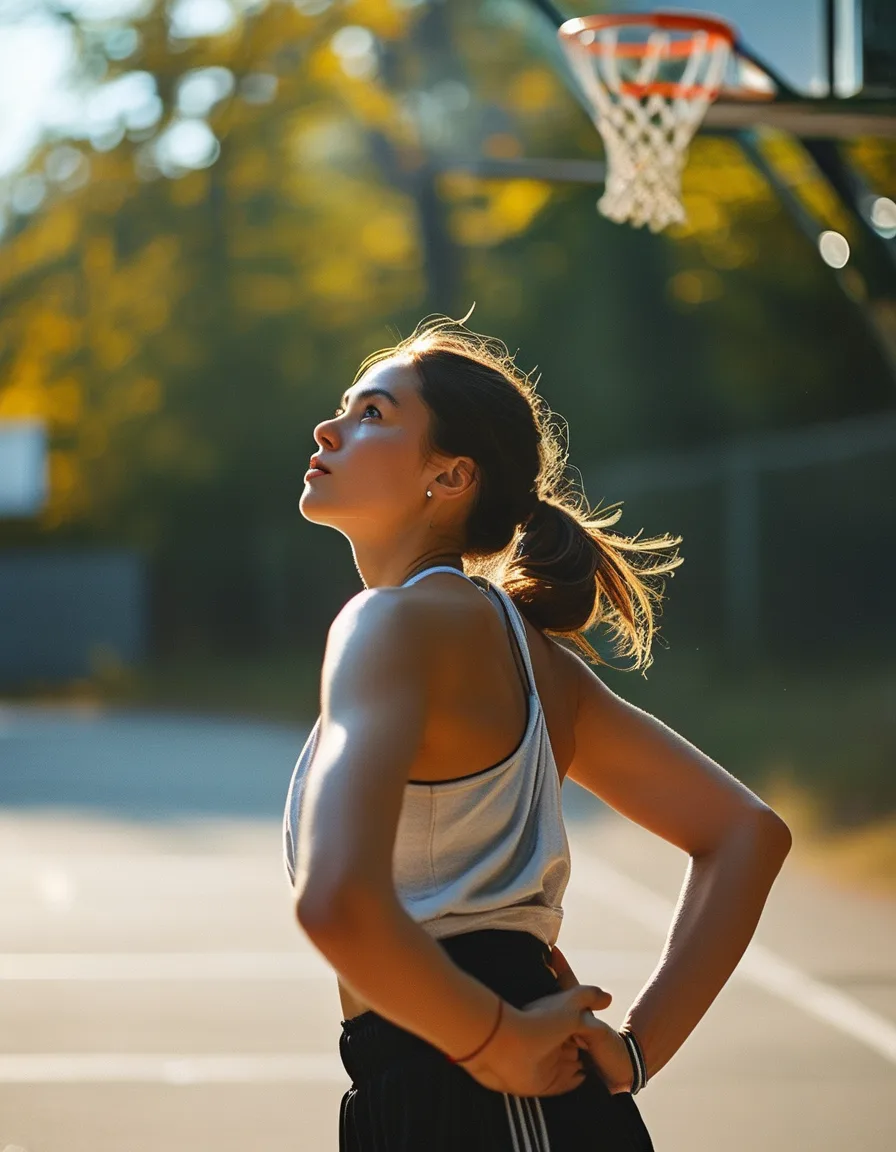
E — Eyes. Fixed on the near edge of the rim, and they stay there. Do not track the ball’s flight. Following the ball with your eyes pulls your head — and your whole shot — off line. Pick the front of the rim and stare at it through the entire release.
E — Elbow. Under the ball, pointing at the basket. Not winged out to the side. This is the single most common flaw in self-taught shooters and the one that causes left-right misses. Put your shooting hand under the ball and look down: your forearm should form a vertical line.
F — Follow-through. Wrist snapped down, fingers pointing into the imaginary cookie jar on a high shelf. Hold it until the ball hits the rim. The hold isn’t showmanship — it’s what prevents you from cutting the release short.
Run the checklist on every practice shot until it stops needing running.
Why Does Shot Arc Matter So Much?
Because a flat shot is aiming at a much smaller target than an arced one.
A basketball is 9.5 inches across. A rim is 18 inches. That leaves an 8.5-inch margin — but only if the ball comes in from directly above.
A flat line-drive shot approaching at 30 degrees sees an effective opening that’s dramatically narrower, because the ball is passing through an ellipse rather than a circle. It has to be nearly perfect to go in.
A shot entering at around 45 degrees sees close to the full 18 inches. It also has a far better chance of a friendly bounce off the back rim, rather than the flat shot’s brutal front-rim clang.
The cue that fixes it: shoot UP, not AT. Picture dropping the ball into the hoop from above rather than throwing it toward the hoop. Most players who make this one change gain several percentage points immediately.
Ugly-high beats line-drive every single time. Nobody has ever lost a game because their shots were too arced.
What’s the Ten-Minute Daily Shooting Drill?
Close-range perfection radiates outward. Distance is earned, never rushed.
Minutes 1–2: One-hand form shots from one meter. Stand directly in front of the rim, one meter out. Shooting hand only — guide hand behind your back. Perfect elbow, perfect follow-through, high arc. About 20 shots. If you’re missing from one meter with one hand, your form has a mechanical problem, and no amount of three-point practice will fix it.
Minutes 3–6: Free-throw range, full BEEF audit. Two hands now. Before each shot, say one BEEF letter to yourself and check it. About 30 shots. Slow, deliberate, no rebounding rush.
Minutes 7–10: Game-spot shooting with a step-in. Pick three spots you’d actually shoot from in a game. Step into each shot as if catching a pass. About 30 shots, 10 per spot. This is where form meets reality.
Total: roughly 80 shots in ten minutes. Done daily, that’s 560 quality reps a week — considerably more useful than 300 careless ones on a Saturday.
The 5 Mistakes Everyone Makes on Their Own Shot
- Practicing distance before practicing form. Shooting threes with broken mechanics engraves the break. One meter first, always.
- The winged elbow. It feels natural because it’s how you shot at age ten with a ball too heavy for you. It’s now the main source of your left-right misses.
- Guide hand thumb flick. The off hand should be a passenger — resting on the side of the ball and doing nothing at release. If your guide thumb pushes, the ball spins sideways and your misses become unpredictable.
- Shooting flat because it feels more accurate. Flat shots feel controlled and are mathematically worse. Trust the arc.
- Never filming yourself. This is the one that surprises even experienced players — you cannot see your own elbow flare or shortened follow-through from the inside, and both are glaringly obvious on ten seconds of phone video.
How Do You Know If Your Form Is Actually Improving?
Film ten shots weekly. Phone propped on a bag, side-on angle.
What to look for in the footage:
- Is the shooting elbow under the ball at release, or out to the side?
- Does the wrist snap fully and hold, or does the hand stop halfway?
- Does the ball’s peak height reach clearly above the backboard’s top edge on a free throw? If not, add arc.
- Are your feet in the same position on shot one and shot ten? Consistency matters more than any single position.
Track one number too: makes out of 20 free throws, once a week, same conditions. Form changes typically show up in that number within three weeks — before then you’re in the awkward phase where the new motion feels wrong and the old one is gone.
Push through those three weeks. That’s where everyone quits.
Frequently Asked Questions
How long does it take to fix basketball shooting form?
Expect three to six weeks of daily practice before the new mechanics feel natural, with measurable percentage improvement usually appearing around week three. The first two weeks typically feel worse than your old form did — that’s the motor pattern rewriting itself, not a sign the change is wrong.
Should you shoot with one hand or two when practicing form?
Both, in sequence. One-hand form shooting from close range isolates the shooting mechanics without the guide hand interfering, which is why it opens every good practice session. Two-hand shooting from real distance follows once the one-hand version is clean.
What is the ideal arc for a basketball shot?
Around 45 degrees of entry angle is widely cited as optimal, balancing target size against the extra distance the ball travels. Practically, if your shot’s peak is clearly above the top of the backboard on a free throw, your arc is in a good range.
How many shots a day should you take to improve?
Quality matters far more than volume. Eighty deliberate shots with a form check on each beats 400 careless ones. Ten focused minutes daily outperforms two unfocused hours weekly, because motor learning responds to frequency more than to session length.
TL;DR:
- BEEF: Balance (feet loaded), Eyes (near rim, don’t track the ball), Elbow (under the ball), Follow-through (snap and hold).
- Shoot UP, not AT. A ~45-degree entry gives you nearly the full 18-inch rim; a flat shot sees a narrow ellipse.
- Ten minutes daily: 2 min one-hand form shots at one meter, 4 min free-throw range, 4 min game spots.
- Guide hand is a passenger. Any thumb push and the ball spins sideways.
- Film ten shots weekly — elbow flare and a cut follow-through are invisible from the inside. Give it three weeks.
Keep Reading
This article is for general informational and styling purposes only. Fit, sizing, and product availability may vary.