Building a Basketball Warm-Up That Actually Prepares You to Shoot
Quick Answer: A shooting-specific warm-up moves from general to specific in about 15 minutes: five minutes of general movement and dynamic mobility, five minutes of close-range form shooting starting under the basket, and five minutes working outward to your actual shooting range. The mistake is jumping straight to three-pointers, which trains a compensating stroke before your body is ready to produce a clean one.
What you do in the first fifteen minutes determines whether your first ten shots of the game are representative of your ability.
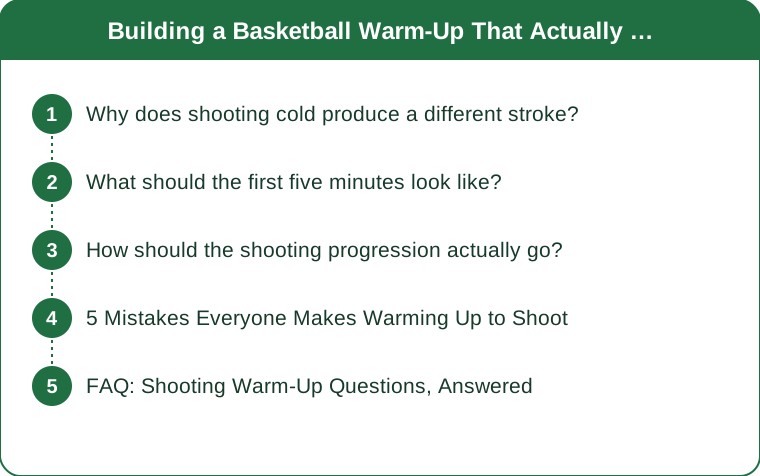
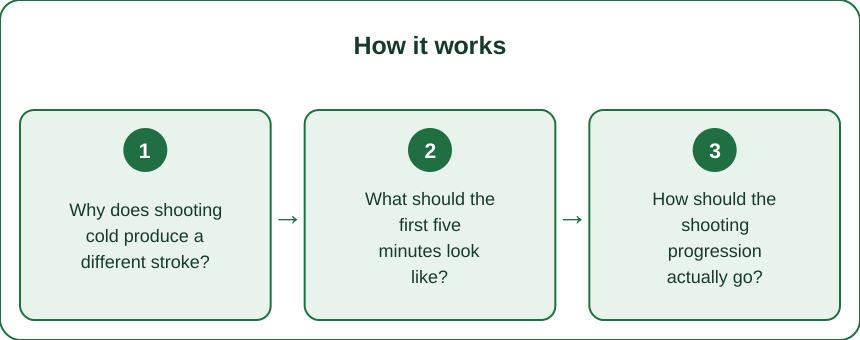
Why does shooting cold produce a different stroke?
Because a cold body compensates, and compensations become habits fast.
What is physically different when cold: muscle temperature is lower, which reduces force production and rate of force development. Joint range is reduced. Neural drive to the muscles is less efficient. The result is that producing the same shot distance requires more effort from more places.
How the compensation shows up: shooters who start cold at long range almost universally introduce extra leg drive, extra shoulder, or a hitch in the release to generate the distance their body cannot yet produce efficiently. All three are stroke changes, and all three feel normal while you are doing them.
Why it matters beyond that session: shooting is a highly repeated motor pattern, and every rep reinforces something. Twenty cold three-pointers with a compensated stroke is twenty repetitions of a stroke you do not want.
The evidence angle: research on warm-up consistently shows improvements in power output, reaction time and movement accuracy following an appropriate warm-up, with the largest gains in tasks requiring fine motor control. Shooting is exactly that kind of task.
The practical implication: the first shots of any session should be the easiest shots you take, and they should be close enough that no compensation is possible.
What should the first five minutes look like?
General movement, not sport-specific, and not static stretching.
The goal is raising tissue temperature and mobilizing the joints you are about to use. Roughly five minutes covers it.
A structure that works:
- 90 seconds of easy movement: jog the perimeter of the court, or a light skip. Enough to feel warm, not enough to fatigue.
- Dynamic lower body: leg swings front to back and side to side, walking lunges with a torso rotation, lateral shuffles, high knees. About two minutes.
- Dynamic upper body: arm circles, shoulder pass-throughs with a towel or band, and thoracic rotations. Ninety seconds. This is the section most players skip, and shooting is an upper body skill built on thoracic and shoulder mobility.
Why not static stretching first: holding a long static stretch before a power or accuracy task has been repeatedly shown to reduce force output temporarily. Save static work for after the session, where it belongs.
On the ankles specifically: basketball demands substantial ankle dorsiflexion, and limited dorsiflexion changes how you load into a jump shot. Thirty seconds of a knee-to-wall ankle mobilization on each side is a small addition with a real effect for a lot of players.
How should the shooting progression actually go?
Start under the basket and move outward, and let the mechanics dictate when you move.
Phase 1: form shooting, right at the rim, one hand. Stand a foot from the basket, shoot with your shooting hand only, guide hand off the ball entirely. Twenty to thirty shots. This isolates the release and removes every source of compensation. It also immediately exposes whether your wrist and fingers are warm.
Phase 2: form shooting from the block, both hands on the ball. Ten to fifteen feet, normal mechanics, no jump or a minimal one. Twenty shots. Focus on the same release you just isolated.
Phase 3: mid-range with normal footwork. Free throw line extended, catch-and-shoot and off-the-dribble. Twenty to twenty-five shots. This is where you add the legs.
Phase 4: your actual range. Three-point line if that is where you shoot, and not before phases one through three feel clean.
The rule that makes this work: do not move outward until the current distance feels effortless. If you are straining at fifteen feet, moving to the arc adds strain rather than removing it. Some days phase three takes longer than others, and honoring that is the whole point.
Total shots in a proper warm-up: roughly 70 to 90 before you take a shot at game speed. That sounds like a lot and takes about ten minutes.
5 Mistakes Everyone Makes Warming Up to Shoot
1. Starting at the three-point line. The most common and most damaging. It guarantees a compensated stroke for the first ten to twenty shots and teaches the compensation at the same time.
2. Making the warm-up a competition. Shooting games with teammates during warm-up shifts attention to outcome instead of mechanics, and it raises intensity before the body is ready. Save the competition for after.
3. Static stretching before shooting. Long holds reduce force output temporarily, which is the opposite of what a shooting warm-up is for. Dynamic before, static after.
4. Skipping the wrists and fingers. The release is a fine motor action driven by small muscles that warm up more slowly than large ones. Thirty seconds of wrist circles, finger flexion and extension, and a few one-handed flicks against a wall makes a noticeable difference to release feel.
5. Not accounting for the environment. A cold gym in October requires a longer warm-up than a warm one in August, and an outdoor court after a summer evening cools quickly. Players who use the identical routine year-round are under-warmed for a chunk of the season.
FAQ: Shooting Warm-Up Questions, Answered
How long before a game should I finish warming up?
Ideally you finish within about 10 to 15 minutes of tip-off. The benefits of a warm-up decay measurably after roughly 20 to 30 minutes of inactivity, which is why long pre-game speeches can leave players cold.
What if I only have five minutes total?
Cut the general portion to 90 seconds of movement, then do form shooting under the basket and from the block only. Do not skip to your range — a shorter warm-up means a shorter shooting range, not a compressed progression.
Does the same warm-up work for practice as for a game?
The structure does. Practice warm-ups can be slightly shorter since you will build intensity gradually anyway, while games benefit from the full version because your first possession is at full speed.
Should I warm up differently coming from an outdoor court to an indoor gym?
Slightly. Indoor rims and floors are more consistent and typically more forgiving, so your calibration shifts. Give yourself extra reps in phases two and three to recalibrate depth before shooting from range.
TL;DR:
- Cold shooting produces compensations, and every compensated rep reinforces a stroke you do not want.
- Five minutes of general movement and dynamic mobility first — never static stretching.
- Shoot outward: one hand at the rim, then the block, then mid-range, then your range.
- Do not move outward until the current distance feels effortless, however long that takes.
- Warm the wrists and fingers specifically; small muscles warm slowly and the release depends on them.
- Finish within 10 to 15 minutes of tip-off, since warm-up benefits decay after about half an hour.
The first fifteen minutes decide whether your first ten shots represent you. Spend them outward from the rim, not in from the arc.
Keep Reading
This article is for general informational and styling purposes only. Fit, sizing, and product availability may vary.