How to Join a Pickup Basketball Game as a Woman (Without the Awkward Wait)
Quick Answer: Pickup runs everywhere operate on the same unwritten system: next is claimed verbally, winners usually stay, and new players get evaluated on exactly three things - do you know the etiquette, do you play hard on defense, and do you make simple plays without hunting shots. Arrive with a ball, claim next early and audibly, pick up sub-in players by name, and spend your first game setting screens, boxing out, and hitting the open pass. Skill earns respect over weeks; those three things earn it in one evening.
The run is full, nobody looks up, and the only other woman in sight is walking a dog past the fence. Every pickup player - every one - stood exactly where you are standing once. The difference between watching and playing is mostly knowing the operating system.

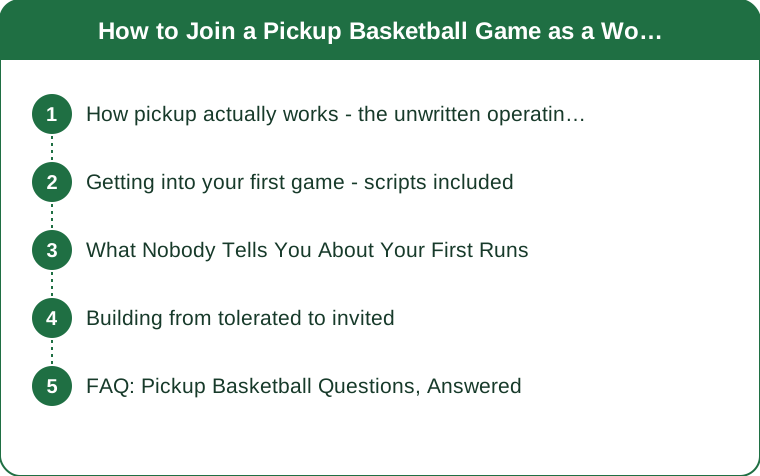
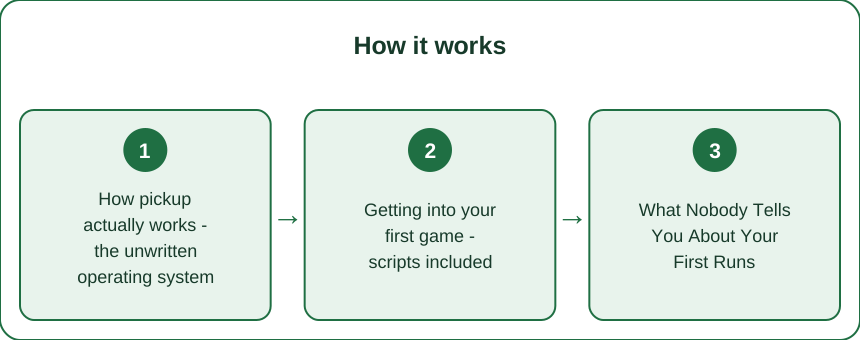
How pickup actually works - the unwritten operating system
Courts differ in detail; the skeleton is nearly universal.
Games go to a number, winners stay. Most outdoor runs play to 11 or 15 by ones and twos, win-by-rules varying. The winning team typically holds the court; the losing team sits if others are waiting. Knowing the local number is your first question on arrival - it marks you as someone who has played.
Next is claimed out loud, not assumed. The person who says I got next, audibly, to the players on the court, owns the next game and picks their squad from whoever is waiting. Standing quietly by the fence claims nothing - this is the single mechanic that leaves newcomers stranded for an hour. If someone already has next, ask do you have five? An incomplete next team is your fastest door in.
Checks, calls, and honor rules. Ball checked at the top after dead balls; offense usually calls its own fouls, and calls are expected to be rare and honest; and take-backs behind the line after a change of possession. Arguing calls as a newcomer costs more social capital than any missed shot ever will.
Warm-up windows are auditions. Between games, the court opens for shooting. This is when you get seen - not for making everything, but for moving like a player: crisp form, chasing your own rebound, returning others’ balls with a pass instead of a roll. Players pick teams off thirty seconds of this all the time.
And bring a ball. The person whose ball is in play is never uninvited. It is the cheapest status item in the sport.
Getting into your first game - scripts included
The gap between the fence and the court is four sentences wide.
Arrive at the right hour. Early evening runs and weekend mornings have rotating crowds and looser rosters; a locked-in Saturday prime-time run of regulars is the hardest door. First visits do better at off-peak, when courts are hungry for a fifth.
Script one, on arrival: who has next? If nobody - I got next, said to the court, not to your shoes. If someone does - you got five? I am in if you need one. That sentence has started thousands of basketball friendships and it works because it solves their problem, not yours.
Script two, when teams are short mid-run: they are down a player and looking around - a simple I will run flips you from spectator to teammate. Courts lose players constantly to time, heat, and ankles; late-game vacancies are the side door that is nearly always unlocked.
Expect the once-over, and let the first defensive possession answer it. Some courts will be visibly unsure about you. That is real, it is annoying, and the counter is not a speech - it is pressure on the ball, a clean box-out, and beating your check down the floor twice. Pickup courts are ruthlessly practical: whoever helps win stays in the rotation. The evaluation window for a woman is often unfairly short and unfairly skeptical - and it also genuinely closes after one good game, which is a trade most players would take.
Find the connector. Every run has one - the player who organizes, greets, settles disputes. Introduce yourself to that person by name. Regulars follow the connector’s lead on who belongs, and one good word from them re-runs your audition with a friendlier judge.
If there is a women’s or mixed run nearby, use it as a base. Many cities have recurring ones; they are the fastest place to build game-shape and a bench of people who will wave you into other runs. Base camp, not a ceiling.

What Nobody Tells You About Your First Runs
Your first-game job is defense and screens, and it is a rigged game you can win. New players who hunt shots get judged on makes; new players who defend hard, box out, screen, and hit the open pass get judged on effort - and effort is fully under your control. One clean skip pass to a shooter buys more next-game invitations than three contested makes.
Call nothing soft for the first hour. Pickup tolerates contact somewhere between rec league and rugby, and the fastest way to lose a court is a string of touch fouls. Save your calls for real ones; when you do call, say it flat and re-check the ball. Paradoxically, the less you call, the more the court polices fouls on you.
The score is always in dispute and it never matters. Someone will lose count every game. The player who says our ball, 7-5, calmly and moves on is doing leadership; the one who litigates is doing paperwork. Courts remember both.
Gear reads before your handle does. Ball shoes, not runners - ankles deserve the lateral support, and regulars notice. Shorts with real pockets are for the walk over, not the run itself; on court, keys and phone sit in your bag at the fence like everyone else’s. Plenty of women run in leggings under shorts or on their own - nobody blinks; what the court reads is whether you dressed to sweat.
Heat management is a skill late-summer runs test hard. August blacktop adds ten degrees to the forecast. Water at the fence, shade between games, and subbing yourself out before your legs go are veteran moves - the newcomer who plays four straight in the sun and fades gave the court its story for the evening.
And the regulars are mostly rooting for you. Under the initial cool once-over, most courts want new reliable players - runs die without them. The skepticism is a filter, not a wall; on the other side of one solid, low-drama evening is a group chat invitation.
Building from tolerated to invited
The second month matters more than the first night.
Show up on a rhythm. Same court, same evenings, two or three visits a week - regularity converts a face into a name. Courts run on reliability: the player who is always there Tuesday at six gets rostered before the better player who appears at random.
Level up your one-on-one honesty. Between runs, work the two skills pickup actually pays for: finishing layups with either hand through contact, and hitting the open catch-and-shoot at your comfortable range. Pickup exposes weak-hand finishing mercilessly and rewards spot shooting endlessly. Twenty minutes of either, twice a week, moves your stock faster than any highlight move.
Learn names, use names. Screens are called with names, switches negotiated with names, and next-team invitations extend to names. Nice pass, Marcus after a game does more roster work than a month of silent competence.
Take the run-organizing jobs nobody wants. Keep the score straight, chase the ball that rolled to the street, referee the down-a-player recruitment at the fence. The person doing the boring court logistics is un-cuttable within three weeks - it is the fastest ascent in the sport and almost nobody contests it.
Recruit one. Bring a friend once you are established - even a beginner. Players who grow the run own a share of it, and arriving as two changes the fence-standing math permanently for both of you.
Keep receipts on the good courts and quit the bad ones. A run that stays hostile after you have done everything here is not a test you are failing; it is a culture doing you a favor by showing itself early. Cities have many courts. The right one feels obvious within three visits - people pass to you, argue with you about a call like a peer, and text when they are down a player. That last one is the diploma.
FAQ: Pickup Basketball Questions, Answered
How do I claim next without feeling awkward?
Say it early, loudly enough for the court, and once: I got next. Then confirm the game point and start assembling five. The awkwardness is one sentence long; the alternative is an hour at the fence. If next is taken, you got five? attaches you to an incomplete team, which is even easier.
What if I am clearly the weakest player on the court?
Play the effort positions: pressure the ball, box out every shot, screen hard, pass to the open player immediately. Weak-but-working is a respected pickup archetype that gets picked again; weak-and-shot-hunting is the one that does not. Skill gaps close with weeks; effort reputation forms in one night.
Do I call fouls in pickup?
Offense calls its own, sparingly - real contact that changed the play, called flat and re-checked without debate. New players should set their bar high for the first few visits; a reputation for honest, rare calls is worth points a game in how the court treats you afterward.
What should I bring to a pickup run?
A ball (the biggest social lever available), water, ball shoes with lateral support, and a dark shirt and light shirt for team-color sorting. Leave jewelry home, park the phone in the bag, and bring cash-free patience - runs start late and argue often, and both are part of the sport.
Is it normal to be the only woman at a run?
Common, yes - and usually a bigger deal at the fence than it is by the second game. Expect a short, skeptical evaluation window, answer it with defense and simple plays, and anchor yourself with a connector and any nearby mixed or women’s run for depth. Courts that stay cold after that are courts to leave; most warm up faster than their first look suggests.
TL;DR:
- Learn the operating system: games to 11 or 15, winners stay, and next exists only if you claim it out loud.
- The scripts: who has next - I got next - you got five? Late-game vacancies and the between-games shooting window are the side doors.
- First-game currency is defense, box-outs, screens, and the open pass - effort is judged in one night, skill over weeks.
- Call almost nothing, keep score calmly, learn names, do the boring court jobs, and show up on a rhythm.
- Ball shoes, water, a ball of your own, and August-blacktop heat sense; leave courts that stay hostile - the right run texts you when they are down a player.
The fence is the hardest court in basketball, and you only have to beat it once. Claim next like you have done it before, and by the third Tuesday you will be the one waving somebody in.
Keep Reading
This article is for general informational and styling purposes only. Fit, sizing, and product availability may vary.