How to Keep Your Ball Handling Sharp Playing Once a Week
Quick Answer: A handle is a motor skill, and motor skills decay with infrequent practice while responding strongly to frequency. One session a week gives you maybe 200 to 400 game dribbles; three 15-minute home sessions give you 1,500 or more, at higher quality. Prioritize two-ball drills, weak-hand volume, and eyes-up work - those three transfer to games far better than anything else you can do without a defender. Space needed: about six feet square.
The reason your handle falls apart against pressure is almost never a lack of moves. It is a lack of repetitions with your eyes off the ball.

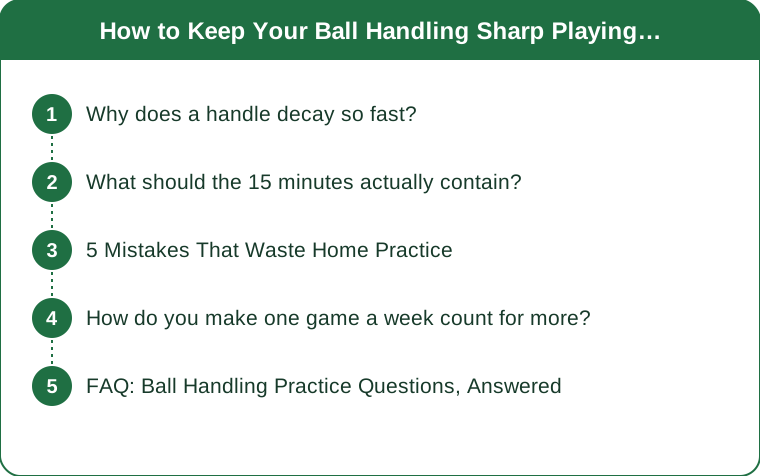
Why does a handle decay so fast?
Because it depends on fine motor control, which is the first thing to go.
Ball handling is a fine motor skill, not a strength quality. Fine motor control degrades faster with disuse than strength or endurance does - a week off costs you noticeably more handle than it costs you conditioning.
Touch is the specific thing that fades. The feel for how hard to push the ball, how it responds off a particular surface, where it will be when your hand returns. This is why the first ten minutes of a pickup game feel foreign even when you have been in the gym regularly.
Game dribbles are a small number. In a full pickup run you might handle the ball meaningfully for a few minutes total. Spread across a week, that is not enough exposure to maintain a skill, let alone build one.
Frequency beats duration for skill retention. Three 15-minute sessions outperform one 45-minute session significantly, because each session provides a fresh consolidation opportunity. This is the single most useful principle in the whole article.
And confidence tracks touch closely. A player who trusts their handle attacks; a player who does not passes early. That difference shows up in games and it is downstream of practice frequency rather than talent.
What should the 15 minutes actually contain?
Four blocks, in this order, with a clock.
Block 1 (3 minutes): stationary warm-up and touch. Pound dribbles at three heights - ankle, knee, waist - 30 seconds each hand. Then figure-eights around the legs, and around-the-world wraps. This is about waking up the hands, not about difficulty.
Block 2 (5 minutes): two-ball work. The highest-value block by a wide margin. Simultaneous dribbles, then alternating, then one high and one low. Two-ball drills force both hands to work independently, which is exactly what weak-hand development requires. Five minutes of two-ball beats twenty minutes of single-ball crossovers.
Block 3 (4 minutes): weak hand only. Pound dribbles, crossovers into the weak hand, in-and-outs, behind-the-back. Volume matters more than variety here - the weak hand needs repetitions, not new moves.
Block 4 (3 minutes): eyes-up and combination work. Every drill from blocks 1 to 3, performed while looking at a fixed point on a wall. Add a simple combination - crossover into between-the-legs, or in-and-out into a retreat dribble - and run it repeatedly.
Total: 15 minutes, three times a week. That is 45 minutes weekly and it will produce more improvement than a doubled amount of unstructured driveway dribbling.

5 Mistakes That Waste Home Practice
1. Watching the ball the whole time. The most common and most costly. A handle that only works with eyes down is a handle that fails against defenders. Pick a spot on the wall and hold it - even if the drill gets sloppier, that sloppiness is the actual training.
2. Practicing only what you are good at. Weak-hand work is unpleasant and it is where the entire improvement is. A useful ratio is 70% weak hand, 30% strong for anyone who wants to fix a lopsided handle within a season.
3. Dribbling too softly. Home practice on a hard surface tempts people to dribble gently. Game dribbles are hard and low. Practicing soft builds a soft handle, and soft handles get stripped.
4. No time constraint or structure. Aimless dribbling while thinking about something else provides repetitions with no attention attached, and attention is what makes practice count. Set a timer for each block.
5. Ignoring the surface difference. Concrete gives a truer, faster bounce than a wooden court; carpet kills the ball completely. If you practice on concrete, expect the gym to feel slightly slower - that is normal, and it is a small adjustment rather than a problem.
The one that surprises people: adding a tennis ball to your off hand while dribbling with the other is the single most effective eyes-up drill available, and it needs almost no space.
How do you make one game a week count for more?
Treat it as the test, not the training, and prepare accordingly.
Warm up your hands before you play. Five minutes of the stationary drills above before a pickup run means you start the game with your touch already awake, rather than finding it during the second half. This alone changes how the first game feels.
Pick one thing to use. Going into a run intending to use your weak hand in traffic, or to attack with a specific move, produces far more skill transfer than playing on instinct. You will play slightly worse and improve considerably faster.
Notice where the handle failed. Was it under close pressure? On the move? Going left? That observation becomes next week’s practice focus, which is how one game a week turns into targeted training.
Play against pressure when you can. Even a single friend applying light defensive pressure for ten minutes provides something no solo drill can - unpredictability. Reaction is the piece home practice cannot supply.
And keep the season in mind. As outdoor courts get cold, wet, and dark through autumn, once-a-week runs become once-a-fortnight without anyone deciding to let that happen. Home practice is what carries a handle through winter - and players who maintain it arrive in spring noticeably ahead of the ones who did not.
FAQ: Ball Handling Practice Questions, Answered
How long before I notice improvement?
Touch improvements show within one to two weeks of consistent practice. Meaningful weak-hand development takes six to eight weeks, and confidence using it in games usually lags a few weeks behind the ability itself.
Do weighted balls help?
They build hand strength and make a normal ball feel easier afterward, which is useful. They are a supplement rather than a base - most of the benefit comes from volume with a normal ball, and weighted work should stay a small proportion of your practice.
Can I practice indoors without annoying everyone?
Low, controlled dribbles on a mat or carpet reduce noise significantly, though carpet deadens the bounce. Two-ball wraps, figure-eights, and stationary ball-slap drills make almost no noise and still build touch.
Is 15 minutes really enough?
Three times a week, yes, for maintenance and steady improvement. Frequency matters more than duration for motor skills - short and often beats long and rare, reliably.
TL;DR:
- Ball handling is a fine motor skill that decays fast with infrequent practice and responds strongly to frequency over duration.
- Three 15-minute sessions weekly beat one long session: touch warm-up, two-ball work, weak hand only, then eyes-up combinations.
- Two-ball drills and weak-hand volume are the highest-transfer work you can do without a defender.
- Warm your hands up before games, pick one thing to use in play, and note where the handle failed.
The frustrating part of playing once a week is that games expose a handle without building one. Fifteen minutes in a driveway three times a week fixes that - and it is what keeps a handle alive through the months when the courts are cold, wet, and dark.
Keep Reading
This article is for general informational and styling purposes only. Fit, sizing, and product availability may vary.