Why You Shoot Great in Practice but Fall Apart in Real Games
Quick Answer: Shooting well in practice but poorly in games is usually a decision-speed problem, not a mechanics problem — practice reps happen with no defender and no time pressure, so a shot that’s grooved in isolation often breaks down the moment it has to be executed under a closing defender and a shot clock.
You’ve hit 8 of 10 from the elbow in an empty gym more times than you can count. Then the whistle blows for real and the same shot clangs off the back rim twice in a row. The mechanics didn’t change — the conditions around them did.

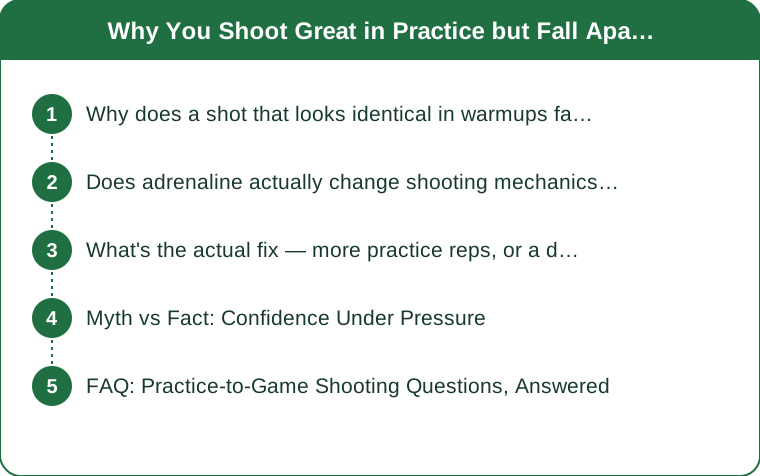
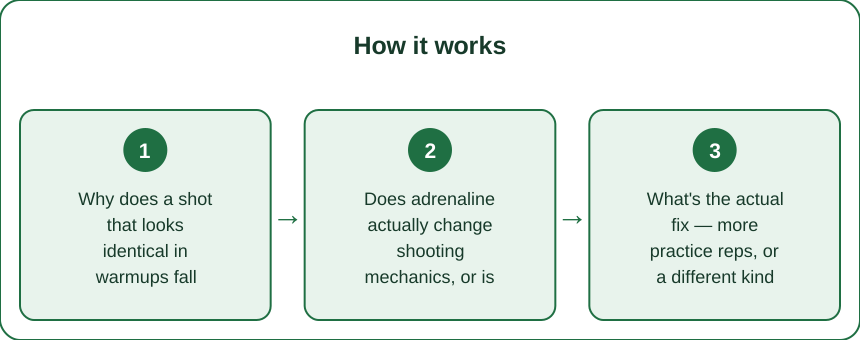
Why does a shot that looks identical in warmups fall apart under game pressure?
Practice shots are almost always taken from a stationary, unpressured setup, while game shots are taken off a catch, a dribble move, or a closeout — with a fraction of the reaction time. Your body hasn’t actually grooved the shot under those specific conditions, only the isolated motion, so the first time it meets real defensive pressure it reverts to a rushed, less controlled version.
Does adrenaline actually change shooting mechanics, or is it purely mental?
It’s both, and they’re connected. Elevated heart rate and adrenaline genuinely affect fine motor control, which is part of why a rushed shot under pressure tends to lose its normal arc and follow-through — but the bigger factor for most players is that game speed compresses decision-making time, and a rushed decision produces a rushed release before the mechanics even get a chance to break down.

What’s the actual fix — more practice reps, or a different kind of practice?
Volume alone doesn’t close this gap — the reps have to include a decision element and some form of pressure to transfer. Shooting off a live closeout, adding a defender applying real (even light) contest, or using a shot clock in practice reps all force the same compressed decision-making that games require, which is what actually grooves the shot for game conditions rather than just for an empty gym.
Myth vs Fact: Confidence Under Pressure
Myth: Players who shoot well in games just have more natural confidence. Fact: confidence under pressure is trainable and comes largely from repetition under realistic conditions — players who consistently practice with defensive pressure and a shot clock report the game shot feeling far more familiar, because it genuinely is more familiar to their nervous system by the time tip-off happens.
FAQ: Practice-to-Game Shooting Questions, Answered
Should I completely stop practicing stationary, unpressured shots?
No — stationary reps are still useful early in a session for grooving pure mechanics; the key is not stopping there, and always progressing to pressured or live-decision reps before the session ends.
How much of my practice time should include pressure or a defender?
Many coaches suggest at least a third of shooting practice should involve some closeout, contest, or time pressure once basic form is solid, increasing that share as a season progresses.
Does this same gap apply to free throws too?
Less so — free throws are taken under a stoppage with no defender in both practice and games, which is part of why free throw percentage tends to translate much more consistently than field goal percentage.
TL;DR:
- A game shot and a practice shot are mechanically the same motion under very different conditions
- Adrenaline and compressed decision time, not lost skill, cause most in-game shooting drop-off
- Adding real defensive pressure or a shot clock to practice reps is what actually transfers
- Free throws translate better precisely because they lack the pressure gap field goals have
The shot isn’t broken — it just hasn’t met game speed enough times yet to feel normal there too.
Keep Reading
This article is for general informational and styling purposes only. Fit, sizing, and product availability may vary.