Why Your Jump Shot Falls Apart When You're Tired
Quick Answer: Fatigue drains leg power first, and most shooters compensate by pushing harder with their arms instead of adjusting their base — that’s why tired shots fall short and lose arc. The fix is shortening your shot slightly, not muscling through with more arm effort.
Your warmup shots look identical to your fourth-quarter shots in terms of form — until you look at where the ball actually lands. Tired shots fall short, flatten out, and miss right or left more than early-game shots. Here’s the mechanism behind that, and the actual fix.

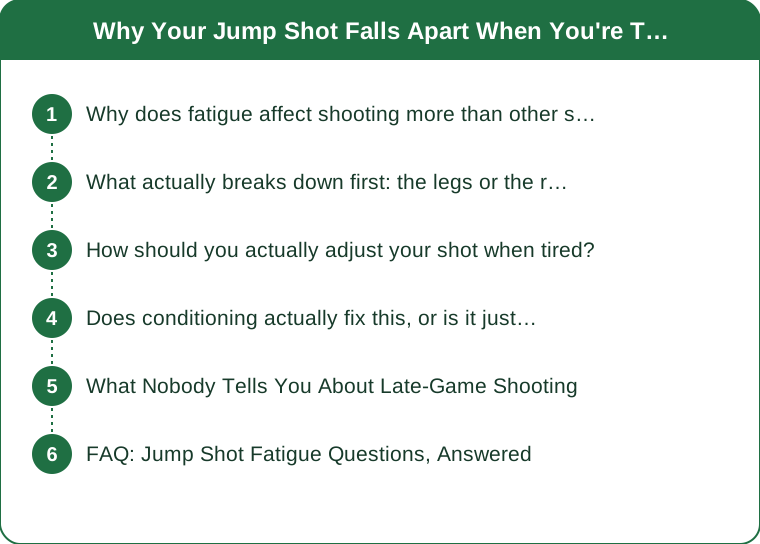
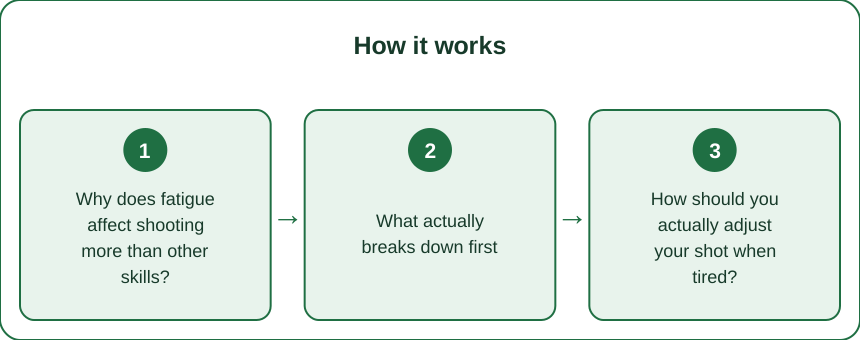
Why does fatigue affect shooting more than other skills?
Because a jump shot’s power comes primarily from your legs, not your arms — legs generate roughly 70% of shot power in a properly mechanically sound shot. Legs also fatigue faster than arms during a game full of cutting, jumping, and defending. When leg power drops, most shooters unconsciously compensate with more arm and wrist effort, which throws off the timing and consistency of a motion built on repetition.
What actually breaks down first: the legs or the release?
The legs, almost always. You’ll typically see a lower, weaker jump before you see the release point change — but the release changes soon after as your body tries to make up for lost leg power. This is why shots start falling short late in games: the arm compensation adds inconsistent extra push instead of the smooth, repeatable power a full leg drive provides.
How should you actually adjust your shot when tired?
Shorten your shot, don’t muscle it. If you’re tired and shooting from a distance that’s normally comfortable, take a half-step closer if the game allows, or consciously aim for a slightly higher arc rather than a harder push. Fighting fatigue with more arm strength almost always makes shots less consistent, not more powerful.
Experienced shooters also shorten their pre-shot routine when tired — less time standing still means less time for the tired legs to further fatigue before the actual jump.

Does conditioning actually fix this, or is it just shooting technique?
Both, but conditioning is the more overlooked lever. Shooting-specific conditioning — sprints followed immediately by shooting reps, rather than shooting in a rested state — trains your body to maintain form under exactly the fatigue conditions a real game creates. Practicing perfect form only when fresh doesn’t transfer well to the fourth quarter, because the compensations your body makes under fatigue are never rehearsed.
What Nobody Tells You About Late-Game Shooting
Elite shooters aren’t immune to fatigue’s effect on their legs — they’re just better at recognizing the drop in leg power and adjusting range and arc before it costs them a shot. The skill isn’t fatigue resistance, it’s fatigue awareness: noticing your legs feel heavier and adjusting your shot selection and mechanics before the misses pile up, rather than after.
FAQ: Jump Shot Fatigue Questions, Answered
Why do my shots fall short specifically when I’m tired?
Because leg power drops first and most compensation from the arms doesn’t fully replace it — the ball loses the last few feet of momentum it needs to reach the rim with a normal arc.
Should I take fewer three-pointers when tired in a game?
If your legs feel noticeably heavy, yes — shortening your shot range or driving instead of shooting from distance is a smarter adjustment than forcing a shot your legs can’t currently power.
How do you train shooting under fatigue specifically?
Pair conditioning drills (sprints, defensive slides) directly with shooting reps in the same practice block, rather than shooting only when fresh. This is how game-realistic fatigue tolerance actually gets built.
TL;DR:
- Legs provide roughly 70% of shot power and fatigue faster than arms — that’s the root cause
- Arm compensation for tired legs is what actually breaks shot consistency, not the fatigue itself
- Shorten your shot or arc when tired instead of pushing harder with your arms
- Train shooting reps directly after conditioning drills to build real fatigue tolerance
A falling-short shot late in the game isn’t a form breakdown — it’s your legs quietly running out before your arms notice.
Keep Reading
This article is for general informational and styling purposes only. Fit, sizing, and product availability may vary.