Why Your Jumpshot Looks Fine in Practice But Falls Apart in Actual Games
Quick Answer: A jumpshot that holds up in practice but breaks down in games is usually a timing and decision-speed problem, not a mechanics problem — practicing shots off a pass or a dribble move under simulated time pressure closes this gap far more effectively than more stationary practice reps.
The form is the same. What’s different is that practice shots come with unlimited time to set up, and game shots don’t.
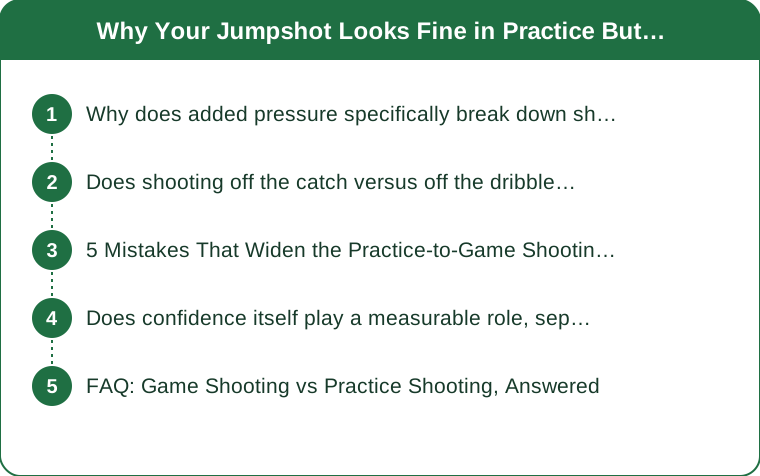
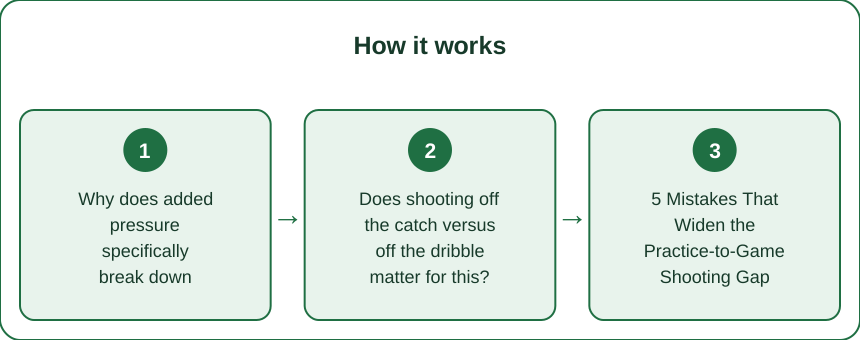
Why does added pressure specifically break down shooting form?
Rushed decision-making under time pressure changes the shot before the release even happens — a slightly quicker gather, a less complete load, a shortened follow-through. The mechanics haven’t actually changed; the time available to execute them has, and that’s usually where the miss originates.
Does shooting off the catch versus off the dribble matter for this?
Yes — most stationary practice reps are shot from a static position with full setup time, while game shots overwhelmingly come off a catch or a live dribble with a defender closing out. Practicing shots specifically off movement, with a simulated time constraint, trains the actual skill being used in games.

5 Mistakes That Widen the Practice-to-Game Shooting Gap
1. Only practicing stationary, unguarded shots. 2. Never adding any time constraint to practice reps. 3. Skipping shots off the dribble or off a pass entirely. 4. Not tracking makes under fatigue, only fresh-leg shooting. 5. Never practicing the first shot of a session under a ‘this one matters’ mindset.
Does confidence itself play a measurable role, separate from mechanics?
It does — hesitation from low in-game confidence often produces the exact same visual breakdown as a genuine mechanical flaw (short release, off-balance landing), which is part of why the same player can look mechanically sound in one context and inconsistent in another.
FAQ: Game Shooting vs Practice Shooting, Answered
How many game-simulated reps are worth adding per practice session?
Even 15-20 shots taken off movement with a self-imposed time constraint, layered into an otherwise normal practice session, meaningfully closes the gap over a few weeks.
Does shooting fatigued at the end of practice help prepare for games?
Yes — a portion of shots taken when already tired more closely mirrors late-game shooting conditions than shooting only when fresh.
Is this gap more common in certain positions?
It shows up across positions, though players who get fewer total game touches often have less opportunity to naturally close this gap through repetition alone.
TL;DR:
- The gap is usually about time pressure and decision speed, not shooting mechanics
- Practicing shots off movement with a simulated time constraint targets the real skill
- Fatigue-based practice reps mirror late-game conditions better than fresh-leg shooting
- Hesitation from low confidence can visually mimic a mechanical flaw
The shot isn’t broken — it’s being asked to happen faster than it’s been trained to.
Keep Reading
This article is for general informational and styling purposes only. Fit, sizing, and product availability may vary.