Why Your Legs Give Out Before Your Lungs in Pickup Basketball
Quick Answer: Basketball is dominated by repeated short, high-intensity efforts with incomplete recovery, which drains phosphocreatine and produces local muscular fatigue in your legs long before your cardiovascular system becomes the limit. Steady-state running builds the aerobic base that helps you recover between those efforts, but it does not build the ability to produce and tolerate repeated hard accelerations, decelerations, and jumps. That requires specific training: repeated sprint work, deceleration and landing strength, and enough lower-body strength to make each effort cheaper.
You run 3 miles four times a week. Your breathing is fine. And by game three your legs feel like they belong to someone else and your jump shot is landing three inches short.
The conditioning is not the problem. It is conditioning for a different sport.

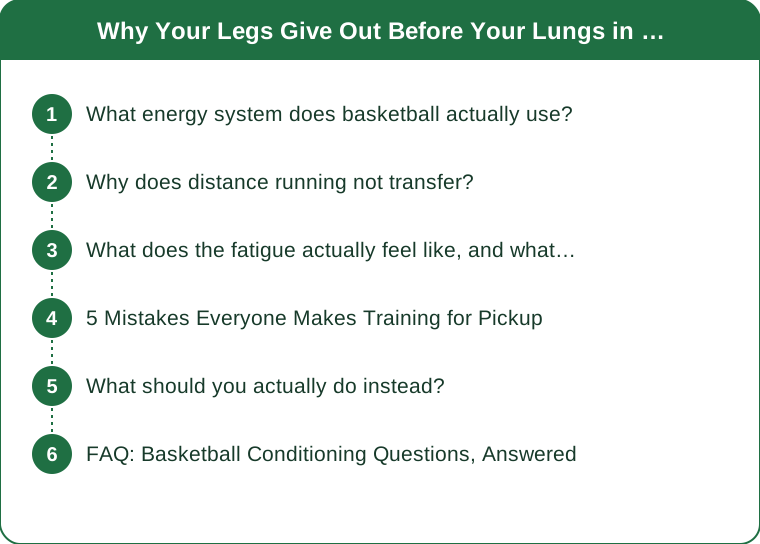
What energy system does basketball actually use?
Basketball is a repeated-sprint sport, and repeated-sprint sports have a distinct physiological signature.
Time-motion analysis of basketball consistently finds a change of activity roughly every 2 seconds, with high-intensity efforts of 2 to 6 seconds separated by incomplete recovery periods of varying length. Over a game, that adds up to hundreds of accelerations, decelerations, and direction changes.
The primary fuel for a 2 to 6 second maximal effort is phosphocreatine, which is stored locally in the muscle and depletes fast. Full resynthesis takes 3 to 5 minutes of genuine rest, which pickup basketball never gives you.
So you enter each successive possession with a smaller PCr reserve than the last one. Your legs are running a fuel deficit that has nothing to do with your lungs.
Meanwhile your aerobic system is barely stressed by any individual effort. It is working hard to resynthesize PCr between efforts, which is why aerobic fitness genuinely matters, but the sensation of aerobic strain never arrives because no single effort is long enough to produce it.
Why does distance running not transfer?
It transfers partly, and the part it does not transfer is the part that fails.
What running gives you: a larger aerobic engine, which speeds PCr resynthesis between efforts, and better cardiac output. That is genuinely valuable and it is why runners can play longer than untrained people.
What running does not give you, at all:
Deceleration capacity. Basketball involves stopping as often as starting, and eccentric loading of the quads during hard deceleration is a major source of muscle damage and fatigue. Steady running has essentially no hard decelerations.
Rate of force development. Producing peak force in under 250 milliseconds is a trained quality. Distance running trains the opposite: sustained submaximal force over long durations.
Lateral and multi-directional strength. Running is almost purely sagittal. Basketball spends a large share of its time moving laterally, and the hip abductors and adductors that control that are undertrained by running.
Landing tolerance. Jumps and landings load tissue very differently from running strides.
The result is a specific pattern: you never get out of breath and your legs are gone by minute 20. That combination is diagnostic.
What does the fatigue actually feel like, and what does that tell you?
The location and quality of the fatigue tell you what to train.
Heavy quads, especially when stopping or landing. Eccentric fatigue from decelerations. Train eccentric strength and deceleration mechanics.
Calves burning and jump height dropping. Local PCr depletion plus calf endurance. Repeated sprint training and calf-specific work help.
Hips feeling weak on defensive slides. Frontal-plane strength gap. Lateral work is missing from your program.
Legs fine but shot short and handles sloppy. This is usually central rather than local. You are fatigued enough that fine motor control degrades before gross strength does. Better conditioning delays this, and so does practicing skills in a fatigued state deliberately.
Genuinely out of breath, chest heaving. This is the one that would point to an aerobic gap, and it is the one most recreational runners do not report. If this is you, more running actually is the answer.

5 Mistakes Everyone Makes Training for Pickup
1. Doing more steady-state cardio when the legs are the limit. Adding a fourth 3-mile run does nothing for PCr capacity, deceleration strength, or rate of force development. It adds fatigue to legs that are already the bottleneck.
2. Skipping strength training because basketball is a cardio sport. Lower-body strength makes every acceleration and jump a smaller percentage of your maximum, which means each one costs less. Strength is conditioning in a repeated-sprint sport.
3. Never training decelerations. Everyone practices sprinting. Almost nobody practices stopping, which is where the eccentric damage comes from and where a lot of knee injuries happen.
4. Doing conditioning with full recovery. Resting 3 minutes between sprints trains a quality basketball never uses. The sport is defined by incomplete recovery, so the training has to be too.
5. Warming up like a runner. Five minutes of easy jogging prepares you for jogging. It does not prepare tissue for maximal accelerations and landings, which is why the first game of the night has the highest injury rate.
The third one is the one that shows up in your quads on Sunday morning and nobody connects it to anything they did or did not train.
What should you actually do instead?
Three additions, roughly two sessions a week total, alongside whatever running you enjoy.
Repeated sprint training, once a week. The format that matches the sport: 6 to 10 sprints of 20 to 30 meters with 20 to 30 seconds of rest between, then 3 minutes rest, repeat for 2 to 3 sets. The incomplete recovery is the whole point. You should be measurably slower on the last rep of each set. If you are not, the rest is too long.
Lower-body strength, twice a week. Squats or split squats, hip hinges, and calf work. Aim for 3 sets of 5 to 8 on the main movements with genuinely challenging weight. This is the highest-leverage item on the list for most recreational players and the one most likely to be skipped.
Deceleration and landing work, folded into the warm-up. Sprint and stop drills, single-leg landings held for 2 seconds, lateral bounds with a controlled stick. Two or three sets of a few reps, twice a week. This is low volume and high value, and it addresses both the fatigue and the injury risk.
Change your warm-up. Before you play: 5 minutes easy movement, then 5 minutes of progressively harder accelerations, decelerations, and lateral movement, then two or three near-maximal efforts. Ten minutes total. Your first game will feel completely different and the injury risk in that game drops substantially.
Season note: as outdoor courts give way to indoor gyms this fall, the surface changes and so does the load. Indoor hardwood offers more grip, which means harder decelerations and more eccentric demand. Expect the first few indoor sessions to produce more soreness than the outdoor games did, and build the deceleration work in now rather than after.
This is general information, not medical advice. Knee pain that persists or that involves swelling or instability is worth having assessed.
FAQ: Basketball Conditioning Questions, Answered
Why am I not out of breath but my legs are done?
Because basketball drains phosphocreatine, which is stored locally in muscle and takes 3 to 5 minutes of real rest to replenish. No single effort is long enough to produce aerobic strain, so your lungs never become the limit.
Does running help basketball conditioning at all?
Yes, partly. A bigger aerobic engine speeds recovery between efforts. It just does not train deceleration, rate of force development, or lateral strength, which are what actually fail.
How long before I notice a difference?
Repeated sprint work usually shows in 3 to 4 weeks. Strength takes 6 to 8 weeks to translate into feeling lighter on the court, but it produces the biggest change once it does.
TL;DR:
- Basketball drains phosphocreatine through hundreds of short maximal efforts with incomplete recovery. Legs fail before lungs because the fuel is stored locally.
- Distance running builds the recovery engine but not deceleration capacity, rate of force development, or lateral strength.
- Add repeated sprint work with deliberately short rest, lower-body strength twice a week, and deceleration and landing drills in the warm-up.
- Warm up with actual accelerations and stops, not five minutes of jogging. The first game of the night is the highest-risk one.
Your cardio is fine. The sport is asking your legs a question your training never asked them.
Keep Reading
This article is for general informational and styling purposes only. Fit, sizing, and product availability may vary.